• A robotic arm that will perform ultrasound • The robot will deliver medicine and food to the patient’s bed
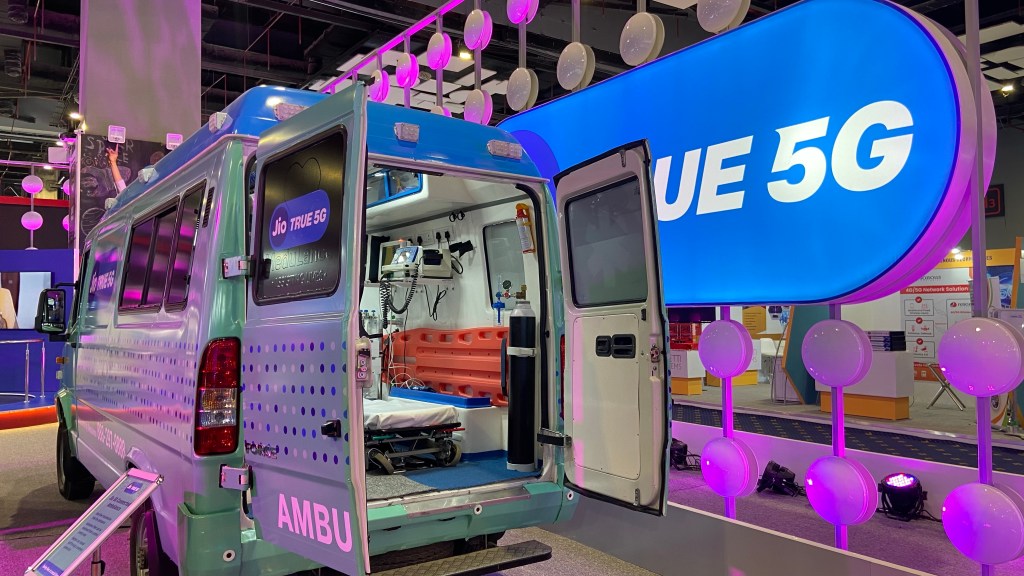
Reliance Jio has introduced a 5G connected ambulance at the Indian Mobile Congress. This is such an ambulance which will digitally deliver all the important information of the patient to the hospital in real time and that too before the patient reaches the hospital. In the event of a medical emergency, the doctor present at the hospital can make all necessary medical arrangements before the patient arrives. You can guess how much the medical industry will change in the future by looking at this ambulance.
The Jio Pavilion will also feature a robotic arm that specializes in X-rays and ultrasounds. In fact, a radiologist or sonographer sitting hundreds of miles away can easily run it through Jio True 5G. This robotic arm will directly connect city-based radiologists with rural patients. For basic medical needs like X-ray and ultrasound, villagers will no longer have to go around the city and the report will also be available at home.
Reliance is launching 5G service on Diwali. Relying on the high speed and low-latency of its True 5G network, Reliance Jio is also working on many technical solutions that will come in handy in everyday life. One of them is Jio 5G Healthcare Automation. Many frontline workers lost their lives in isolation wards of hospitals during the Kovid epidemic. Reliance Jio is working on the technology of 5G controlled robots which will be able to deliver medicines and food to isolation wards as well as other patients.
Due to the use of cloud based 5G controlled robots the margin of error will be zero. With a robot fleet management system, their maintenance and sanitization will also be easier than humans and most importantly, the lives of thousands of frontline workers and patients can be saved.
From predicting outbreaks to devising treatments, doctors are turning to AI in an effort to combat the COVID-19 pandemic.
While machine learning algorithms were already becoming a part of health care, COVID-19 is likely to accelerate their adoption. But lack of data and testing time could hinder their effectiveness — for this pandemic, at least.
With millions of cases and outbreaks in every corner of the world, speed is of the essence when it comes to diagnosing and treating COVID-19. So it’s no surprise doctors were quick to employ AI tools in an effort to get ahead of what could be the worst pandemic in a century.
HealthMap, a web service run by Boston Children’s Hospital that uses AI to scan social media and other reports for signals of disease outbreaks, spotted some of the first signs of what would become the COVID-19 outbreak. This was days before the WHO formally alerted the rest of the world.
Early in the outbreak the Chinese tech company Alibaba released an AI algorithm that uses CT scans of possible coronavirus patients and can diagnose cases automatically in a matter of seconds.
In New York, Mount Sinai Health System and NYU Langone Health have developed AI algorithms that can predict whether a COVID-19 patient is likely to suffer adverse events in the near future and determine when patients will be ready to be discharged. Such systems can help overburdened hospitals better manage the flow of supplies and personnel during a medical crisis.
Even before COVID-19, AI was already becoming a bigger part of modern health care. Nearly $2 billion was invested in companies involved in health care AI in 2019, and in the first quarter of 2020, investments hit $635 million — more than four times the amount seen in the same period of 2019, according to digital health technology funder Rock Health.
The advance of AI is partially a result of the rapid increase in data, the lifeblood of any machine learning system. The amount of medical data in the world is estimated to double every two months.
Engineer and entrepreneur Peter Diamandis told Wired an estimated 200 million physicians, scientists and technologists are now working on COVID-19, generating and sharing data “with a transparency and at speeds we’ve never seen before.”
“We understand who is at risk and how they’re at risk, and then we can get the right treatment to them,” says Zeeshan Syed, the CEO of Health[at]Scale, an AI health care startup.
In trials, at least, AI has demonstrated a decent record of success, especially when it comes to rapidly diagnosing COVID-19 by interpreting medical scans.
A study published in Nature Medicine this month found an AI system was more accurate than a radiologist in diagnosing COVID-19 patients using CT scans — X-ray images of lungs — combined with clinical symptoms.
A systematic review of preprint and published studies of AI diagnostic systems for COVID-19 published in the British Medical Journal in April noted the models reported “good to excellent predictive performance,” but cautioned the data was still limited for real-world applications and at high risk for bias.
That’s the perennial challenge for AI systems in any field. Experts worry models that perform well in an experiment may not be able to replicate that success in a hospital under stress.
“There is a lot of promise in using algorithms, but the data in the biomedical space can be really difficult to deal with,” says Gabe Musso, the chief science officer at BioSymetrics, a biomedical AI company that uses machine learning for simulation-based drug discovery. Genetic data, imaging data and data from electronic health records are often unstructured and rarely share a common format, complicating efforts to feed the information into an algorithm.
Many of the AI diagnostic systems being rushed into the fight against COVID-19 were developed before the pandemic and thus were trained on other respiratory diseases like tuberculosis. That reduces their accuracy — especially if their training datasets don’t match the gender or age of typical COVID-19 patients.
As a result, pioneering computer scientist Kai-fu Lee wrote recently, “I would give [AI] a B-minus at best” for its performance during the pandemic.
As both the size and quality of medical data on COVID-19 improves, so should the AI systems that draw from it. But that will take time.
“AI will not be as useful for COVID as it is for the next pandemic,” Rozita Dara, a computer scientist at the University of Guelph, told Science recently. (Source: Axios)
The COVID-19 pandemic will accelerate digital adoption in India as increasing number of people shop online and small businesses digitise, Morgan Stanley said crediting Reliance Jio’s 4G telecom services for spurring the digital economy by propelling internet usage in the country.
In a 53-page report on ‘India’s Digital Economy in a Post-COVID-19 World’, Morgan Stanley said 2020 will likely see increasing online penetration in grocery and will put a few Super Apps into motion.
India’s total online shopper base at 30 per cent of its internet population is low when compared with 78 per cent in China and 70-plus per cent in the US.
Morgan Stanley projected India’s 670 million internet users to rise to 914 million by 2027 and online shoppers to jump to 590 million from 190 million in 2020. The average spend per online shoppers is also projected to nearly double to USD 318.
While in the past few years digital adoption in India has been evolving with increasing 4G adoption and rising internet penetration, the overall transactional base was still small.
“The launch of Reliance Jio’s 4G telecom services in September 2016 helped spur the digital economy in India as it propelled internet usage in the country, with fast, reliable, and cheap 4G services leading to significant growth in data usage (especially on music and video content),” it said.
Morgan Stanley said COVID-19 has relieved some apprehension relating to digital transactions. “We believe COVID-19 could accelerate the shift to online transactions (such as e-commerce and payments) and provide a tailwind to growth in India’s digital economy.”
Stating that a larger increase in its online shopping base is needed to drive growth in its digital economy, it said COVID-19 has the potential to do just that.
The power of online has been seen in the past few months as start-ups helped consumers shop, pay for bills, converse, entertain, and collaborate without much physical contact.
“We believe that this digital adoption has the power to pull growth forward by a few years in India’s internet industry,” it said.
The analyst said in a post-COVID-19 world, “India’s online shopping population could see a sharp increase, online penetration in grocery could finally inflect as e-commerce and new entrants make a bigger push in this category, digitization of small and medium business (SMB) enterprises could take centre-stage (and) investments in segments such as gaming, edtech, healthtech, and cloud could increase.”
Also, the country could see the emergence of a few large tech companies (Super Apps or category leaders) in the next 5-10 years.
“These developments are notably important for some of the global tech companies that are invested in India,” it said.
Stating that India could see the emergence of some large tech companies in the next 5-10 years, Morgan Stanley said Amazon and Flipkart, amongst the e-commerce companies, and Paytm and PhonePe, amongst the digital payment companies, have been trying to build several offerings on their platforms.
However, their penetration in their core categories (retail/payments) is still small and hence, the ability to make huge investments in other segments/categories is limited by both capital and management/execution bandwidth, it said.
“Another company that is talking about creating a digital ecosystem is Reliance Industries/Reliance Jio. With 388 million 4G users on its platform, it has touched more than 50 per cent of the total internet base in India,” it said adding the company has talked about plans of foraying into the digital economy with Jiomart (its new commerce offering), payments, health tech, edtech, cloud services, agri tech, etc.
Morgan Stanley said the war is heating up on grocery, with potential digitization of small business, an initiative similar to Alibaba’s LST in China.
“Online grocery is characterized by its large potential market size (USD 400 billion), low penetration (0.2 per cent), customer stickiness, and high repeat rate, and hence ticks most boxes for large companies to have a significant presence in the segment, more importantly, if one were to think about emerging as a Super App,” it said.
Reliance Retail and WhatsApp have entered into a commercial agreement to accelerate Reliance Retail’s new commerce business on the Jiomart platform using WhatsApp. Jiomart is a platform that helps RIL support small merchants and Kirana stores in serving end-consumers.
Reliance aims to focus on 60 million micro, small and medium-sized businesses along with the 30 million small merchants and millions of SMEs with the digital platform, it added.
Amazon India has also announced a USD 1 billion investment over the next five years to digitize 10 million SMBs, enabling USD 10 billion in cumulative exports by Indian businesses selling on Amazon worldwide by 2025, it added

 GO DIGITAL