High speed internet, OTT apps, network reliability makes it attractive
Millions of customers migrate from DTH services
In an unprecedented shift, millions of Indians are turning their backs on traditional Direct-To-Home (DTH) services, opting instead for Fiber connections as their primary source of entertainment. Recent data from the Telecom Regulatory Authority of India (TRAI) highlights a dramatic downturn in DTH subscriptions, with over 13.20 lakh customers severing ties with their DTH providers in the last quarter alone.
The move towards Fiber connections signifies a profound change in the entertainment consumption habits of the Indian population. Unlike the DTH services, which have been criticized for their susceptibility to service disruptions caused by weather conditions and technical faults, Fiber connections offer a robust and reliable alternative. These connections not only guarantee uninterrupted service but also provide superior performance, making them an attractive option for consumers.
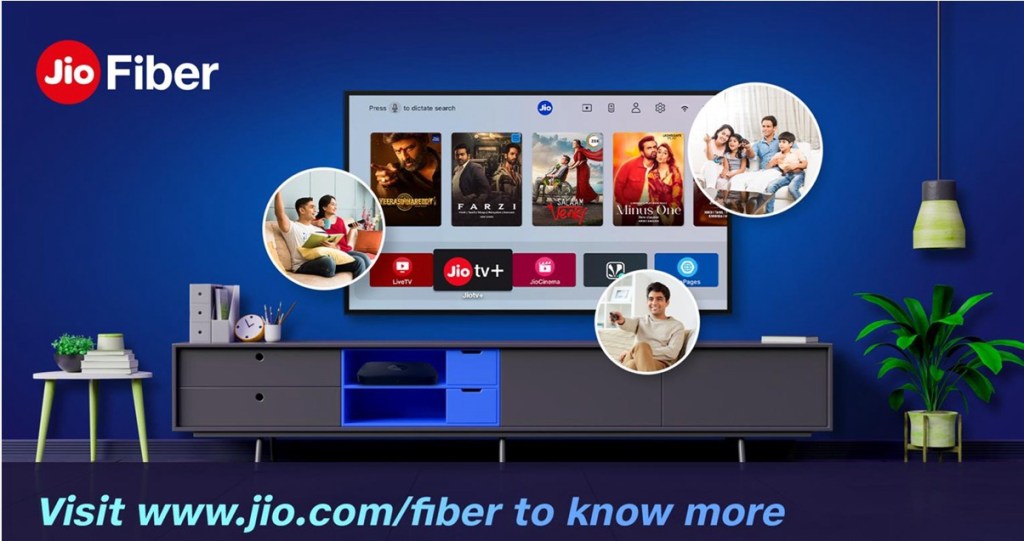
The rise of Over-The-Top (OTT) apps and platforms such as Jio Cinema and JioTV, have played a pivotal role in this transition. These platforms, accessible via Fiber connections, offer a rich array of content including live sports, the latest movies, and popular TV shows, catering to the varied tastes of Indian viewers. This seamless integration of internet and entertainment services through Fiber connections has particularly resonated with the country’s youth, who are at the forefront of adopting these modern entertainment solutions.
Statistics reveal that over 2.23 crore users have already made the switch to Fiber connections, underscoring the growing preference for internet-based entertainment platforms over traditional DTH services. This shift not only marks a significant transformation in how entertainment is consumed in India but also signals the decline of DTH services, once a staple in Indian households.
As the country continues to navigate through this entertainment evolution, the preference for Fiber connections over DTH services is a testament to the changing dynamics of the Indian entertainment landscape, heralding a new era where Fiber is king.
Hyderabad, July 2023- As the monsoon season brings its share of challenges, Jio Fiber has come forward with an unparalleled offering to ensure uninterrupted entertainment and connectivity for its valued customers. The new Jio Fiber TV plan promises to deliver the most reliable and uninterrupted Cable TV and Internet service during this rainy season, making it the ideal choice for residents in Telangana.
Renowned as the best broadband provider across Telangana, Jio Fiber has once again raised the bar by launching its most affordable entertainment Jio TV plan starting at just Rs. 398 per month. This incredible plan boasts a myriad of benefits that will revolutionize the way customers experience entertainment and connectivity at home.
Key highlights of the Jio Fiber TV plan include:
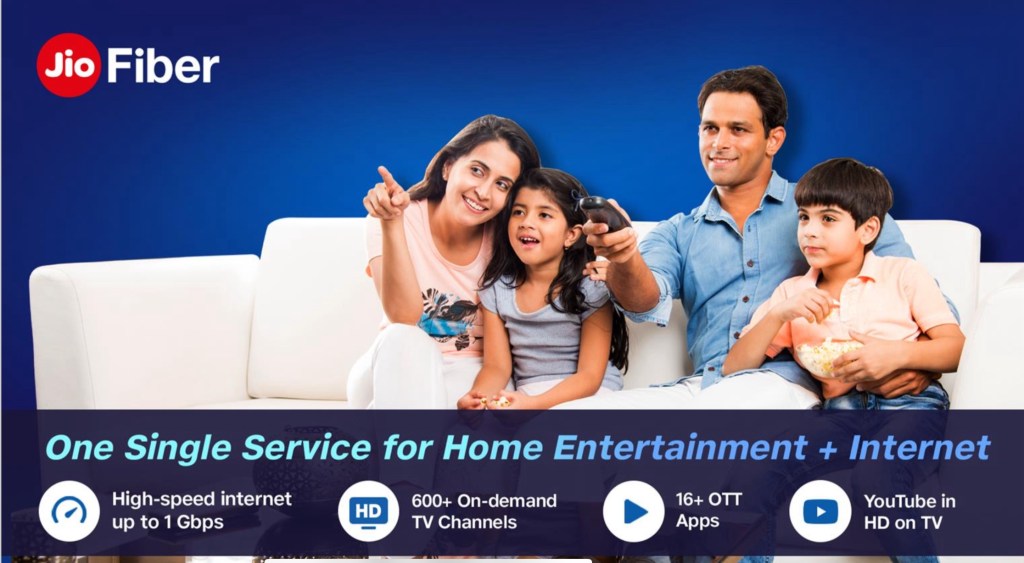
750+ live TV channels covering a diverse range of genres to cater to every member of the family.
Access to 14 of the most popular premium OTT platforms, including Netflix, Amazon Prime, Disney Hot Star, SunNxt, SonyLiv, Zee5, and more, at absolutely no extra cost. Customers can now binge-watch their favourite shows and movies without any constraints.
Complementary Internet plan with unlimited data, ensuring seamless streaming and browsing experiences.
A free landline with unlimited calls, allowing customers to stay connected with their loved ones without worrying about call charges.
To sweeten the deal even further, Jio Fiber is introducing an exclusive Monsoon Offer. Customers availing the Monsoon Offer will receive a Free 4K Set-Top Box, along with a Free Giga Router worth Rs. 10,000, making their home entertainment setup even more advanced and enjoyable. Additionally, there will be Zero Installation charges and Zero deposit to remove any barriers for customers to embrace the Jio Fiber experience. The Monsoon Offer comes with a simple requirement – customers need to opt for an advance recharge for a period of 6 months, unlocking the full potential of this incredible offer.
With Jio Fiber’s commitment to providing top-notch services and unmatched value, customers can now brave the rainy season outside while enjoying non-stop entertainment inside their homes.
So why wait? Embrace the future of entertainment and connectivity with Jio Fiber’s new TV plan. To know more and subscribe, visit your nearest Jio Store or log on to http://www.jio.com/fiber.
Termed ‘the network of networks,’ the fifth generation of wireless mobile networks, 5G will set the benchmark for wireless network standards- A Republic World Report
In a major development, India’s biggest spectrum auction, which will pave the way for high-speed 5G services, is likely to conclude by July end. The rollout of 5G is expected to happen by September this year, union Telecommunication and IT Minister Ashwini Vaishnaw had informed. The Centre approved the 5G spectrum auction, which is now scheduled to commence on July 26.
The fifth generation of wireless mobile networks, 5G will set the benchmark for network standards. Compared to previous generations – 2G, 3G and 4G, the 5G network is set and offers much higher data speeds. Termed ‘the network of networks,’ 5G is expected to be more reliable with lower response times and greater capacity. The network is due to unite many existing standards and cross different technologies while bettering all services on the internet.
Why do we need 5G?
The most evident advantage of the 5G network is the high speed. The increased speed will enable seamless buffering, and greater downloads while helping e-commerce. Reduced latency means faster response time. The increased speed will also open up a large potential application across industries. 5G mobile telecommunications is expected to support the creation of smart factories along with other services like holographic technologies etc.
The Centre has mentioned that in eight top technology institutes of India, the 5G test bed is set up which is speeding up the launch of domestic 5G technology in India. For the launch of 5G services, India is soon to get a strong ecosystem which will likely to about 10 times faster than 4G. It is noted that in the entire 5G ecosystem, Spectrum is an integral and necessary part.
5G rollout in India
In an auction to be held by the end of July 2022, a total of 72097.85 MHz of spectrum with a validity period of 20 years will be put up. The auction will be held for spectrum in various Low (600 MHz, 700 MHz, 800 MHz, 900 MHz, 1800 MHz, 2100 MHz, 2300 MHz), Mid (3300 MHz) and High (26 GHz) frequency bands. Airwaves worth Rs 4.3 lakh crores is expected to be sold at the auction.
Meanwhile, it is being said that the bidders will be given an option to surrender the spectrum after 10 years with no future liabilities with respect to balance instalments. According to reports, the initial rollout will begin in August in a phased manner and full-fledged 5G services will be rolled out by March 2023. Reliance Jio, Bharti Airtel and Vodafone India are being said to be the main buyers.
The COVID-19 pandemic will accelerate digital adoption in India as increasing number of people shop online and small businesses digitise, Morgan Stanley said crediting Reliance Jio’s 4G telecom services for spurring the digital economy by propelling internet usage in the country.
In a 53-page report on ‘India’s Digital Economy in a Post-COVID-19 World’, Morgan Stanley said 2020 will likely see increasing online penetration in grocery and will put a few Super Apps into motion.
India’s total online shopper base at 30 per cent of its internet population is low when compared with 78 per cent in China and 70-plus per cent in the US.
Morgan Stanley projected India’s 670 million internet users to rise to 914 million by 2027 and online shoppers to jump to 590 million from 190 million in 2020. The average spend per online shoppers is also projected to nearly double to USD 318.
While in the past few years digital adoption in India has been evolving with increasing 4G adoption and rising internet penetration, the overall transactional base was still small.
“The launch of Reliance Jio’s 4G telecom services in September 2016 helped spur the digital economy in India as it propelled internet usage in the country, with fast, reliable, and cheap 4G services leading to significant growth in data usage (especially on music and video content),” it said.
Morgan Stanley said COVID-19 has relieved some apprehension relating to digital transactions. “We believe COVID-19 could accelerate the shift to online transactions (such as e-commerce and payments) and provide a tailwind to growth in India’s digital economy.”
Stating that a larger increase in its online shopping base is needed to drive growth in its digital economy, it said COVID-19 has the potential to do just that.
The power of online has been seen in the past few months as start-ups helped consumers shop, pay for bills, converse, entertain, and collaborate without much physical contact.
“We believe that this digital adoption has the power to pull growth forward by a few years in India’s internet industry,” it said.
The analyst said in a post-COVID-19 world, “India’s online shopping population could see a sharp increase, online penetration in grocery could finally inflect as e-commerce and new entrants make a bigger push in this category, digitization of small and medium business (SMB) enterprises could take centre-stage (and) investments in segments such as gaming, edtech, healthtech, and cloud could increase.”
Also, the country could see the emergence of a few large tech companies (Super Apps or category leaders) in the next 5-10 years.
“These developments are notably important for some of the global tech companies that are invested in India,” it said.
Stating that India could see the emergence of some large tech companies in the next 5-10 years, Morgan Stanley said Amazon and Flipkart, amongst the e-commerce companies, and Paytm and PhonePe, amongst the digital payment companies, have been trying to build several offerings on their platforms.
However, their penetration in their core categories (retail/payments) is still small and hence, the ability to make huge investments in other segments/categories is limited by both capital and management/execution bandwidth, it said.
“Another company that is talking about creating a digital ecosystem is Reliance Industries/Reliance Jio. With 388 million 4G users on its platform, it has touched more than 50 per cent of the total internet base in India,” it said adding the company has talked about plans of foraying into the digital economy with Jiomart (its new commerce offering), payments, health tech, edtech, cloud services, agri tech, etc.
Morgan Stanley said the war is heating up on grocery, with potential digitization of small business, an initiative similar to Alibaba’s LST in China.
“Online grocery is characterized by its large potential market size (USD 400 billion), low penetration (0.2 per cent), customer stickiness, and high repeat rate, and hence ticks most boxes for large companies to have a significant presence in the segment, more importantly, if one were to think about emerging as a Super App,” it said.
Reliance Retail and WhatsApp have entered into a commercial agreement to accelerate Reliance Retail’s new commerce business on the Jiomart platform using WhatsApp. Jiomart is a platform that helps RIL support small merchants and Kirana stores in serving end-consumers.
Reliance aims to focus on 60 million micro, small and medium-sized businesses along with the 30 million small merchants and millions of SMEs with the digital platform, it added.
Amazon India has also announced a USD 1 billion investment over the next five years to digitize 10 million SMBs, enabling USD 10 billion in cumulative exports by Indian businesses selling on Amazon worldwide by 2025, it added
 GO DIGITAL