Jio Promises ‘True 5G’ Experience

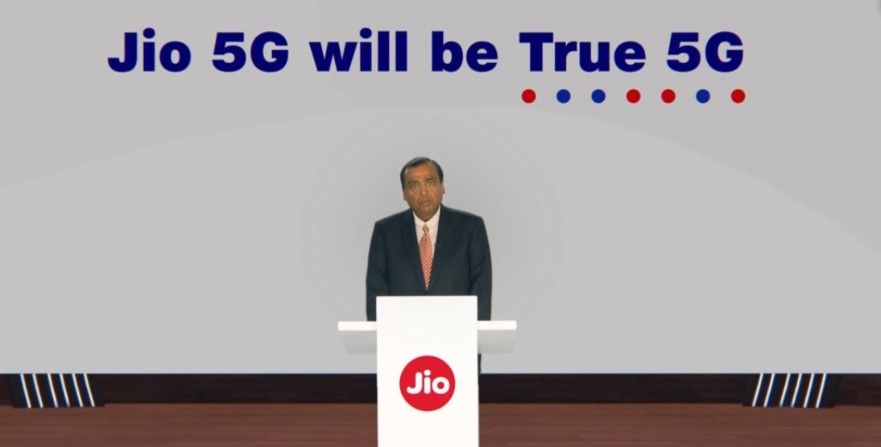
While India is awaiting the launch of 5G services by Prime Minister Narendra Modi on October 1st at India Mobile Congress (IMC) in New Delhi, Reliance Jio is all set to deliver its promise of ‘True 5G’ services to its customers.

Jio 5G promises to be a stand-alone 5G network, which is not the case with most 5G networks available in the world right now. Most operators rely on the non-standalone 5G network, which basically transmits 5G radio signals over an existing 4G network. Following this methodology is unlikely to give improved performance to the users.

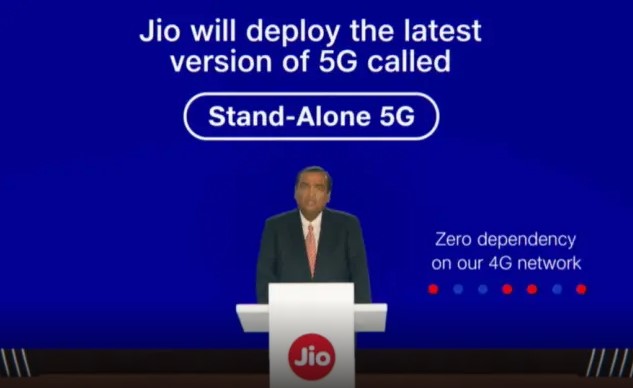
Jio 5G will be called a stand-alone 5G network that will have zero dependency on its 4G network. The True 5G network can offer powerful services and deliver performance at low latency, ideal for massive machine-to-machine communication, deliver 5G voice, edge computing and network slicing, and metaverse, among others.

Jio has planned its True 5G network in a calculated manner, which started by acquiring the largest and the most appropriate mix of wireless spectrum for 5G. Jio has acquired 5G spectrums in the 3500 MHz mid-band segment, which is globally earmarked for 5G, and the 26 GHz millimeter-wave band for ultra-high capacity. But where Jio 5G becomes a True 5G network is thanks to the 700 MHz low-band spectrum which is essential for deep indoor coverage.

“Three-fold advantage of Stand-Alone 5G architecture, largest and best mix of spectrum, and Carrier Aggregation means that Jio 5G will be able to offer an unparalleled combination of coverage, capacity, quality, and affordability,” Reliance Industries Chairman, Mukesh Ambani highlighted during the recent Annual General Meeting (AGM).

Addressing shareholders he said, Jio 5G will be the world’s largest and most advanced 5G network as the carrier is planning to deploy the latest version of 5G, called Stand Alone 5G, that will have no dependency on its 4G network.

In contrast, rivals are looking at Non-Stand Alone 5G, which was called a “hasty way to nominally claim’’ a 5G launch.

Jio was the only carrier to have acquired expensive spectrum in the 700 MHz band by spending almost 40,000 crore rupees in an auction earlier this year, when no other rival thought the airwaves were worth the money.

The 700 MHz band provides better network coverage due to low frequency and has the ability to penetrate buildings efficiently. This will enable it to offer better, stable and faster connectivity in dense urban areas such as Delhi, Mumbai, Kolkata, Hyderabad, etc, experts said.

The acquisition of pan-India 700 MHz band by Jio has also been targeted at attracting high end users to its network aiming to become the primary SIM for them. The driving factor for high average revenue per user (ARPU) users will be an offer of better voice call quality indoors and differentiated 5G offerings. Jio is working with Google to develop an ultra-low cost 5G smartphone which will further strengthen the offerings of the largest telecom player.
Stand Alone 5G vs Non-Stand Alone 5G

Jio is betting that a Stand Alone network with its 700 MHz band will ensure better consumer experience which could drive higher revenue market share and reduce network operating costs. It also has long-term advantages like superior quality ultra-low latency 5G experience and differentiated and wider range of applications particularly for the key enterprise segment.

For Jio, a launch in sub-GHz bands will ensure better consumer experience which could drive higher revenue market share and reduce network operating costs. It also has long-term advantages like superior quality ultra-low latency 5G experience and differentiated and wider range of applications particularly for the key enterprise segment.

This could help the company to poach high-end customers from its competitors – likely increasing competition at the high end, analysts observe.

Also, it costs less to provide broadband services in the 700 MHz band as compared to, say, the 2,100 MHz band. A sub-GHz band— bands below 1000 MHz—offers better coverage with speed without consuming much power.

Jio will be launching 5G services in key cities including metro cities by Diwali with a gradual expansion month-on-month and by the end of December 2023, every part of the country will be covered with Jio 5G. It has announced an investment of Rs 2 lakh crore to build Jio 5G.


What Is 5G, Why Do We Need It?

Termed ‘the network of networks,’ the fifth generation of wireless mobile networks, 5G will set the benchmark for wireless network standards- A Republic World Report

Photo by Vanderlei Longo on Pexels.com

In a major development, India’s biggest spectrum auction, which will pave the way for high-speed 5G services, is likely to conclude by July end. The rollout of 5G is expected to happen by September this year, union Telecommunication and IT Minister Ashwini Vaishnaw had informed. The Centre approved the 5G spectrum auction, which is now scheduled to commence on July 26.

The fifth generation of wireless mobile networks, 5G will set the benchmark for network standards. Compared to previous generations – 2G, 3G and 4G, the 5G network is set and offers much higher data speeds. Termed ‘the network of networks,’ 5G is expected to be more reliable with lower response times and greater capacity. The network is due to unite many existing standards and cross different technologies while bettering all services on the internet.

Why do we need 5G?

The most evident advantage of the 5G network is the high speed. The increased speed will enable seamless buffering, and greater downloads while helping e-commerce. Reduced latency means faster response time. The increased speed will also open up a large potential application across industries. 5G mobile telecommunications is expected to support the creation of smart factories along with other services like holographic technologies etc.

The Centre has mentioned that in eight top technology institutes of India, the 5G test bed is set up which is speeding up the launch of domestic 5G technology in India. For the launch of 5G services, India is soon to get a strong ecosystem which will likely to about 10 times faster than 4G. It is noted that in the entire 5G ecosystem, Spectrum is an integral and necessary part.

5G rollout in India

In an auction to be held by the end of July 2022, a total of 72097.85 MHz of spectrum with a validity period of 20 years will be put up. The auction will be held for spectrum in various Low (600 MHz, 700 MHz, 800 MHz, 900 MHz, 1800 MHz, 2100 MHz, 2300 MHz), Mid (3300 MHz) and High (26 GHz) frequency bands. Airwaves worth Rs 4.3 lakh crores is expected to be sold at the auction.

Meanwhile, it is being said that the bidders will be given an option to surrender the spectrum after 10 years with no future liabilities with respect to balance instalments. According to reports, the initial rollout will begin in August in a phased manner and full-fledged 5G services will be rolled out by March 2023. Reliance Jio, Bharti Airtel and Vodafone India are being said to be the main buyers.

TRAI Recommends 36% Cut In Pan India Spectrum Pricing

Releasing its much-awaited recommendations, the telecom regulator said that all available spectrum in the existing bands of 700 MHz, 800 MHz, 900 MHz, 1800 MHz, 2100 MHz, 2300 MHz, 2500 MHz and the new spectrum bands of 600 MHz, 3300-3670 MHz and 24.25-28.5 GHz, will be put to auction.

Issuing a statement, Trai said, “To provide flexibility to the telecom service providers, block size of 10 MHz for 3300-3670 MHz band and 50 MHz for 24.25-28.5 GHz band recommended. Spectrum to be assigned in a contiguous manner.”

In all, the reserve price across various bands works out to be nearly 39 per cent lower than that suggested last time.

For the prime 5G frequency of 3300-3670 MHz band, all-India reserve price adds up to ₹317 crore per MHz, which is over 35 per cent lower than the ₹492 crore/MHz suggested by Trai last time.

The base price for coveted 700 Mhz band works out to be ₹3,927 crore per Mhz, which is 40 per cent lower than that proposed last time.

The Telecom Regulatory Authority of India (Trai) said that for the long-term growth and sustainability of the telecom sector, infusing liquidity and encouraging investment, the telecom service providers should be allowed easy payment options, including part payment with flexibility of moratorium.

TRAI recommendations can be accessed here… https://www.trai.gov.in/notifications/press-release/trai-releases-recommendations-auction-spectrum-frequency-bands

Getting 5G Ready…

TRAI picks Delhi airport, Bengaluru metro and Kandla port for 5G pilots

The telecom regulator (TRAI) has identified Delhi airport, ‘smart’ city Bhopal, the Bengaluru metro, and Deendayal port (Kandla) in Gujarat for conducting pilot projects using street furniture and aerial cable for the deployment of small cells, Business Standard reported.

These pilot projects are crucial to understand the regulatory and policy interventions which will be required, especially with the launch of 5G services, when more small cells will become the backbone to support a larger traffic volume per unit area.

While macro towers will be deployed as they were for 4G, huge proliferation of small cells, which have a coverage area as low as 10 metres to a few kilometres, is expected to ensure high data speeds and low latency, especially with the use of high band spectrum. The Cellular Operators Association of India has been pushing to include small cells in the Telecom Regulatory Authority of India’s (Trai’s) framework for right of way.

For Full report of Business Standard, click here

Advantage India: Demand for 5G and anger towards China has given us a chance

Demand for 5G is rising — schools to governments, all depend on internet and technology now. And India is uniquely placed to fill in network gap left by China’s 5G

In the Covid chaos, there is arguably one winner: technology. Healthcare, businesses, households, schools, governments — all rely on it now. Work from home to G20 meet, technology is helping a world in lockdown function.

This surge in the use of technology, especially in communications, reinforces more than ever the need for 5G network. An expected exponential rise in data traffic, increasing machine to machine connections across various industries, partnerships and alliances for 5G monetisation, and rising adoption of Internet of Things (IoT) devices will continue to drive the demand for 5G. And yet, this demand for 5G will not be without its fair share of geopolitical ramblings.

Even before Covid-19 had sparked a new war of words between the US and China, the trade dispute had been escalating between the two economic giants. And at its centre was Huawei, a major 5G equipment manufacturer from China. Some in the West suspect Huawei to be the Chinese state’s backdoor to global surveillance. This led to Huawei either being barred from 5G networks in countries such as the US and Australia or allowed limited participation in countries such as the United Kingdom. Now, as 63 countries, including India, again confront China—this time over the mishandling of COVID-19—Beijing may find itself even more isolated over global 5G investments.

So, what do these trends—the soaring need for 5G and geopolitical wrangling over equipment manufacturing—mean for India? A lot, actually.
India has the potential to offset any disruption to global supplies from Chinese companies in the 5G space.

Even before Covid-19 had sparked a new war of words between the US and China, the trade dispute had been escalating between the two economic giants. And at its centre was Huawei, a major 5G equipment manufacturer from China. Some in the West suspect Huawei to be the Chinese state’s backdoor to global surveillance. This led to Huawei either being barred from 5G networks in countries such as the US and Australia or allowed limited participation in countries such as the United Kingdom. Now, as 63 countries, including India, again confront China—this time over the mishandling of COVID-19—Beijing may find itself even more isolated over global 5G investments.

So, what do these trends—the soaring need for 5G and geopolitical wrangling over equipment manufacturing—mean for India? A lot, actually.
India has the potential to offset any disruption to global supplies from Chinese companies in the 5G space. (Read more on The Print)