Jio Platforms Teams with NVIDIA to Bring State-of-the-Art AI Cloud Infrastructure to India

Jio Platforms Limited today announced plans to build a state-of-the-art cloud-based AI compute infrastructure to accelerate India’s position as a growing force in artificial intelligence, in collaboration with NVIDIA.

The new AI cloud infrastructure will enable researchers, developers, startups, scientists, AI practitioners and others across India to access accelerated computing and high-speed, secure cloud networking to run workloads safely and with extreme energy efficiency.

The new infrastructure will greatly speed up a wide range of India’s key initiatives and AI projects, including AI chatbots, drug discovery, climate research and more.

As part of the collaboration, NVIDIA will provide Jio with end-to-end AI supercomputer technologies including CPU, GPU, networking, and AI operating systems and frameworks for building the most advanced AI models. Jio will manage and maintain the AI cloud infrastructure and oversee customer engagement and access.

Mukesh Ambani, Chairman & Managing Director, Reliance Industries Limited, said on the partnership, “As India advances from a country of data proliferation to creating technology infrastructure for widespread and accelerated growth, computing and technology super centres like the one we envisage with NVIDIA will provide the catalytic growth just like Jio did to our nation’s digital march. I am delighted with the partnership with NVIDIA and looking forward to a purposeful journey together.”

Akash Ambani, Chairman of Reliance Jio Infocomm Limited, said, “At Jio, we are committed to fuelling India’s technological renaissance by democratizing access to cutting-edge technologies. Our collaboration with NVIDIA is a significant step in this direction. Together, we will develop an advanced AI cloud infrastructure that is secure, sustainable, and are deeply relevant to India’s unique opportunities. This state-of-the-art platform will be a catalyst in accelerating AI-driven innovations across sectors, from healthcare and education to enterprise solutions. Our vision is to make AI accessible to researchers, start-ups, and enterprises across the nation, thereby accelerating India’s journey towards becoming an AI powerhouse.”

“We are delighted to partner with Reliance to build state-of-the-art AI supercomputers in India,” said Jensen Huang, founder and CEO of NVIDIA. “India has scale, data and talent. With the most advanced AI computing infrastructure, Reliance can build its own large language models that power generative AI applications made in India, for the people of India.”

JIO TRUE 5G LAUNCHED IN HYDERABAD

Post the successful Beta-launch of Jio True-5G services in six cities, namely, Mumbai, Delhi, Kolkata, Chennai, Varanasi and Nathdwara, Jio is extending Jio True-5G’s reach across more cities, namely Bengaluru & Hyderabad. JioTrue5G, in these two tech-centric cities will help realize the true potential of some of the latest technologies that will serve humanity and improve the quality of life of Indians.

Being a customer-obsessed organization, Jio is rolling out its advanced True-5G services in a phase-wise manner, to ensure the best customer experience. JioTrue5G is already being experienced by Lakhs of users across six cities, response to which is extremely positive and reassuring. Customer insights and feedback is helping Jio build, what is, and will be, the most advanced 5G network globally.

Jio users are experiencing speeds anywhere between 500 Mbps to 1 Gbps on their smartphones and are using very high quantities of data, seamlessly, thanks to Jio True-5G’sthree-fold advantage that makes it the only TRUE 5G network in India:

  1. Stand-alone 5G architecture with advanced 5G network with Zero dependency on 4G network.
  1. The largest and best mix of 5G spectrum across 700 MHz, 3500 MHz, and 26 GHz bands.
  1. Carrier Aggregation that seamlessly combines these 5G frequencies into a single robust “data highway” using an advanced technology called Carrier Aggregation.

Starting 10th November, Jio users in Bengaluru and Hyderabad will be invited to the Jio Welcome Offer, to experience Unlimited Data at up to 1 Gbps+ speeds, at no additional cost.

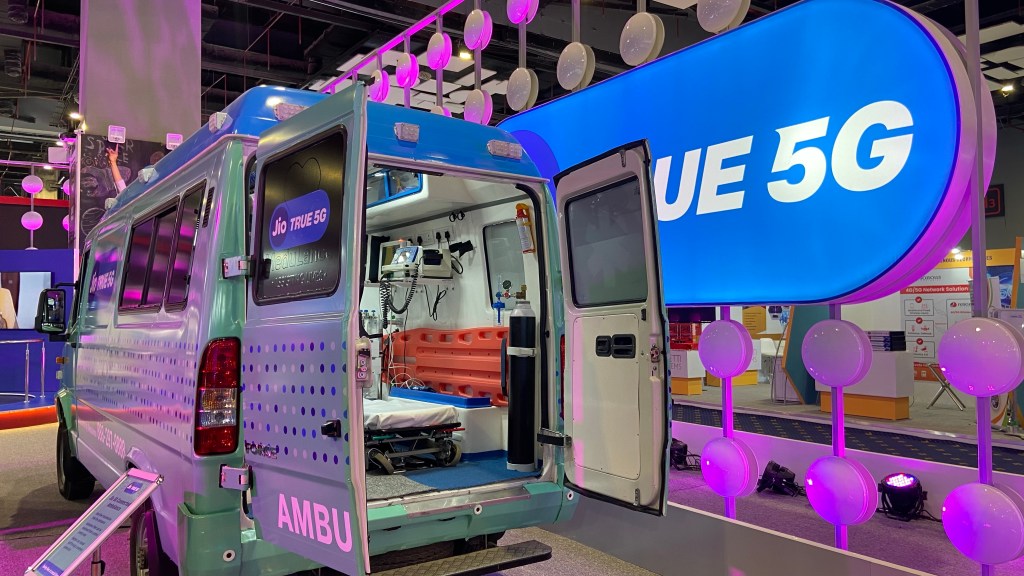
5G Connected Ambulance : Jio’s ‘True 5G’ to revolutionise remote healthcare!

• A robotic arm that will perform ultrasound
• The robot will deliver medicine and food to the patient’s bed

Reliance Jio has introduced a 5G connected ambulance at the Indian Mobile Congress. This is such an ambulance which will digitally deliver all the important information of the patient to the hospital in real time and that too before the patient reaches the hospital. In the event of a medical emergency, the doctor present at the hospital can make all necessary medical arrangements before the patient arrives. You can guess how much the medical industry will change in the future by looking at this ambulance.

The Jio Pavilion will also feature a robotic arm that specializes in X-rays and ultrasounds. In fact, a radiologist or sonographer sitting hundreds of miles away can easily run it through Jio True 5G. This robotic arm will directly connect city-based radiologists with rural patients. For basic medical needs like X-ray and ultrasound, villagers will no longer have to go around the city and the report will also be available at home.

Reliance is launching 5G service on Diwali. Relying on the high speed and low-latency of its True 5G network, Reliance Jio is also working on many technical solutions that will come in handy in everyday life. One of them is Jio 5G Healthcare Automation. Many frontline workers lost their lives in isolation wards of hospitals during the Kovid epidemic. Reliance Jio is working on the technology of 5G controlled robots which will be able to deliver medicines and food to isolation wards as well as other patients.

Due to the use of cloud based 5G controlled robots the margin of error will be zero. With a robot fleet management system, their maintenance and sanitization will also be easier than humans and most importantly, the lives of thousands of frontline workers and patients can be saved.

The 5G Game Play!

India Telcos Detailed Plans For The Big Launch…

5G launch in India in India is in full swing. The Department of Telecommunications (DoT) has announced that the 5G services will roll out this year. Jio, Airtel, and Vi, on the other hand, have been long working towards making the network that can virtually connect everyone and everything together including machines, objects, and devices such as 5G-capable smartphones a reality in the country. That said, don’t expect the countrywide availability of the network immediately after the launch. The 5G services will take time to mature and initially be available in a handful of cities.

The Indigenous 5G testbed project, funded by the telecom department, has been completed by December 31st, 2021. The government is now gearing up for the 5G spectrum auction, which is expected in early June. Following this, the 5G services will start rolling out in India from August-September onwards. Airtel and Jio both have claimed to be the first telecom operator to launch the 5G network in India.

DoT in a press statement has confirmed that the 5G services will be available in as many as 13 cities across the country in 2022. These cities include Delhi, Gurugram, Bengaluru, Kolkata, Chandigarh, Jamnagar, Ahmedabad, Chennai, Hyderabad, Lucknow, Pune, and Gandhi Nagar. All three major telecom operators, Jio, Airtel, and Vi (Vodafone Idea), have already set up 5G trial sites in these cities.

Jio to pioneer the 5G network revolution

Jio is said to pioneer the 5G network revolution in India. The company’s chairman Mukesh Ambani has announced that it’ll take the lead on the network in the country. Jio claims that it’ll easily upgrade to a 5G network from 4G, owing to the telco’s converged network infrastructure. Jio’s 5G will be powered by the indigenously developed network, hardware and technology components, Ambani added. It’s believed that the telco may buy 700MHz in the upcoming auction to fulfil its 5G ambitions unless the government announced the auction of 3300-3600MHz, which is globally popular for 5G deployments at the moment.

Airtel is yet to reveal its plans to launch 5G in the country. The company believes that the next generation of mobile technology needs more time to be rolled out across the country. As per Airtel chief executive Gopal Vittal, the 5G ecosystem in the country is underdeveloped right now and that spectrum is expensive. “The fundamental issue with 5G is spectrum cost, which is way over the top,” he added. That said, the telco is 5G-ready. Airtel announced the deployment of India’s first state-of-the-art Massive Multiple-Input Multiple-Output (MIMO) technology, which is a key enabler for 5G networks, in 2017. The company has already deployed the technology in Bangalore, Kolkata, and several other regions in the country.

Vodafone Idea is all set to roll out 5G in India as soon as the spectrum is made available through auction. The company has upgraded its 4G network with 5G architecture and other technologies like dynamic spectrum refarming (DSR) and MIMO. “Our network is very much 5G-ready. When the 5G auction takes place, we will be able to launch 5G. However, there is a need to develop India 5G use cases. India is unique and some global use cases might not be relevant,” Vodafone Idea MD and CEO Ravinder Takkar said during the AGM meeting last year. The telco has also proposed 5G trials with multiple vendors, including Huawei and Ericsson.

Source click here

What Is 5G, Why Do We Need It?

Termed ‘the network of networks,’ the fifth generation of wireless mobile networks, 5G will set the benchmark for wireless network standards- A Republic World Report

Photo by Vanderlei Longo on Pexels.com

In a major development, India’s biggest spectrum auction, which will pave the way for high-speed 5G services, is likely to conclude by July end. The rollout of 5G is expected to happen by September this year, union Telecommunication and IT Minister Ashwini Vaishnaw had informed. The Centre approved the 5G spectrum auction, which is now scheduled to commence on July 26.

The fifth generation of wireless mobile networks, 5G will set the benchmark for network standards. Compared to previous generations – 2G, 3G and 4G, the 5G network is set and offers much higher data speeds. Termed ‘the network of networks,’ 5G is expected to be more reliable with lower response times and greater capacity. The network is due to unite many existing standards and cross different technologies while bettering all services on the internet.

Why do we need 5G?

The most evident advantage of the 5G network is the high speed. The increased speed will enable seamless buffering, and greater downloads while helping e-commerce. Reduced latency means faster response time. The increased speed will also open up a large potential application across industries. 5G mobile telecommunications is expected to support the creation of smart factories along with other services like holographic technologies etc.

The Centre has mentioned that in eight top technology institutes of India, the 5G test bed is set up which is speeding up the launch of domestic 5G technology in India. For the launch of 5G services, India is soon to get a strong ecosystem which will likely to about 10 times faster than 4G. It is noted that in the entire 5G ecosystem, Spectrum is an integral and necessary part.

5G rollout in India

In an auction to be held by the end of July 2022, a total of 72097.85 MHz of spectrum with a validity period of 20 years will be put up. The auction will be held for spectrum in various Low (600 MHz, 700 MHz, 800 MHz, 900 MHz, 1800 MHz, 2100 MHz, 2300 MHz), Mid (3300 MHz) and High (26 GHz) frequency bands. Airwaves worth Rs 4.3 lakh crores is expected to be sold at the auction.

Meanwhile, it is being said that the bidders will be given an option to surrender the spectrum after 10 years with no future liabilities with respect to balance instalments. According to reports, the initial rollout will begin in August in a phased manner and full-fledged 5G services will be rolled out by March 2023. Reliance Jio, Bharti Airtel and Vodafone India are being said to be the main buyers.

Getting 5G Ready…

TRAI picks Delhi airport, Bengaluru metro and Kandla port for 5G pilots

The telecom regulator (TRAI) has identified Delhi airport, ‘smart’ city Bhopal, the Bengaluru metro, and Deendayal port (Kandla) in Gujarat for conducting pilot projects using street furniture and aerial cable for the deployment of small cells, Business Standard reported.

These pilot projects are crucial to understand the regulatory and policy interventions which will be required, especially with the launch of 5G services, when more small cells will become the backbone to support a larger traffic volume per unit area.

While macro towers will be deployed as they were for 4G, huge proliferation of small cells, which have a coverage area as low as 10 metres to a few kilometres, is expected to ensure high data speeds and low latency, especially with the use of high band spectrum. The Cellular Operators Association of India has been pushing to include small cells in the Telecom Regulatory Authority of India’s (Trai’s) framework for right of way.

For Full report of Business Standard, click here

COVID-19 pushes India on digital adoption: Morgan Stanley

The COVID-19 pandemic will accelerate digital adoption in India as increasing number of people shop online and small businesses digitise, Morgan Stanley said crediting Reliance Jio’s 4G telecom services for spurring the digital economy by propelling internet usage in the country.

In a 53-page report on ‘India’s Digital Economy in a Post-COVID-19 World’, Morgan Stanley said 2020 will likely see increasing online penetration in grocery and will put a few Super Apps into motion.

India’s total online shopper base at 30 per cent of its internet population is low when compared with 78 per cent in China and 70-plus per cent in the US.

Morgan Stanley projected India’s 670 million internet users to rise to 914 million by 2027 and online shoppers to jump to 590 million from 190 million in 2020. The average spend per online shoppers is also projected to nearly double to USD 318.

While in the past few years digital adoption in India has been evolving with increasing 4G adoption and rising internet penetration, the overall transactional base was still small.

“The launch of Reliance Jio’s 4G telecom services in September 2016 helped spur the digital economy in India as it propelled internet usage in the country, with fast, reliable, and cheap 4G services leading to significant growth in data usage (especially on music and video content),” it said.

Morgan Stanley said COVID-19 has relieved some apprehension relating to digital transactions. “We believe COVID-19 could accelerate the shift to online transactions (such as e-commerce and payments) and provide a tailwind to growth in India’s digital economy.”


Stating that a larger increase in its online shopping base is needed to drive growth in its digital economy, it said COVID-19 has the potential to do just that.

The power of online has been seen in the past few months as start-ups helped consumers shop, pay for bills, converse, entertain, and collaborate without much physical contact.


“We believe that this digital adoption has the power to pull growth forward by a few years in India’s internet industry,” it said.


The analyst said in a post-COVID-19 world, “India’s online shopping population could see a sharp increase, online penetration in grocery could finally inflect as e-commerce and new entrants make a bigger push in this category, digitization of small and medium business (SMB) enterprises could take centre-stage (and) investments in segments such as gaming, edtech, healthtech, and cloud could increase.”

Also, the country could see the emergence of a few large tech companies (Super Apps or category leaders) in the next 5-10 years.


“These developments are notably important for some of the global tech companies that are invested in India,” it said.

Stating that India could see the emergence of some large tech companies in the next 5-10 years, Morgan Stanley said Amazon and Flipkart, amongst the e-commerce companies, and Paytm and PhonePe, amongst the digital payment companies, have been trying to build several offerings on their platforms.

However, their penetration in their core categories (retail/payments) is still small and hence, the ability to make huge investments in other segments/categories is limited by both capital and management/execution bandwidth, it said.


“Another company that is talking about creating a digital ecosystem is Reliance Industries/Reliance Jio. With 388 million 4G users on its platform, it has touched more than 50 per cent of the total internet base in India,” it said adding the company has talked about plans of foraying into the digital economy with Jiomart (its new commerce offering), payments, health tech, edtech, cloud services, agri tech, etc.

Morgan Stanley said the war is heating up on grocery, with potential digitization of small business, an initiative similar to Alibaba’s LST in China.

“Online grocery is characterized by its large potential market size (USD 400 billion), low penetration (0.2 per cent), customer stickiness, and high repeat rate, and hence ticks most boxes for large companies to have a significant presence in the segment, more importantly, if one were to think about emerging as a Super App,” it said.

Reliance Retail and WhatsApp have entered into a commercial agreement to accelerate Reliance Retail’s new commerce business on the Jiomart platform using WhatsApp. Jiomart is a platform that helps RIL support small merchants and Kirana stores in serving end-consumers.


Reliance aims to focus on 60 million micro, small and medium-sized businesses along with the 30 million small merchants and millions of SMEs with the digital platform, it added.

Amazon India has also announced a USD 1 billion investment over the next five years to digitize 10 million SMBs, enabling USD 10 billion in cumulative exports by Indian businesses selling on Amazon worldwide by 2025, it added

It’s time Governments push for high digital adoption

One of the big outcomes of the Coronavirus pandemic has been the rise of digitisation in different sectors and all spheres of life. While the private sector has always been at the forefront of this adoption, the Government still has a long way to go.

Currently, technology implementation in government and government-run services has been selective and in very small portions. It is high time that the Governments should push for more digitisation. Opinion makers call for more collaboration between different States in India and urge the Centre to give more levy to States to set up more manufacturing parks which will in turn encourage Prime Minister’s call for Vocal for Local.

Digitisation has become the need of the hour and if it has to flourish then we need three things — digital literacy, digital infrastructure and digital innovation. While the National Digital Literacy Mission needs to be strengthened it is also important that States also concentrate on digital literacy. In terms of infrastructure, as a nation we need to look at digitisation as a basic right so as to make a digital revolution. And finally, it is also important that digital innovation reaches each and every citizen,” Telangana IT Minister Rama Rao opined in a recent virtual digital summit.

While India’s ability to lead large corporates is recognised worldwide, it is still considered to be a services oriented nation and for this to change the Centre and State governments need to encourage more product companies from India and design strategies and policies for this endeavour.