Post the successful Beta-launch of Jio True-5G services in six cities, namely, Mumbai, Delhi, Kolkata, Chennai, Varanasi and Nathdwara, Jio is extending Jio True-5G’s reach across more cities, namely Bengaluru & Hyderabad. JioTrue5G, in these two tech-centric cities will help realize the true potential of some of the latest technologies that will serve humanity and improve the quality of life of Indians.
Being a customer-obsessed organization, Jio is rolling out its advanced True-5G services in a phase-wise manner, to ensure the best customer experience. JioTrue5G is already being experienced by Lakhs of users across six cities, response to which is extremely positive and reassuring. Customer insights and feedback is helping Jio build, what is, and will be, the most advanced 5G network globally.
Jio users are experiencing speeds anywhere between 500 Mbps to 1 Gbps on their smartphones and are using very high quantities of data, seamlessly, thanks to Jio True-5G’sthree-fold advantage that makes it the only TRUE 5G network in India:
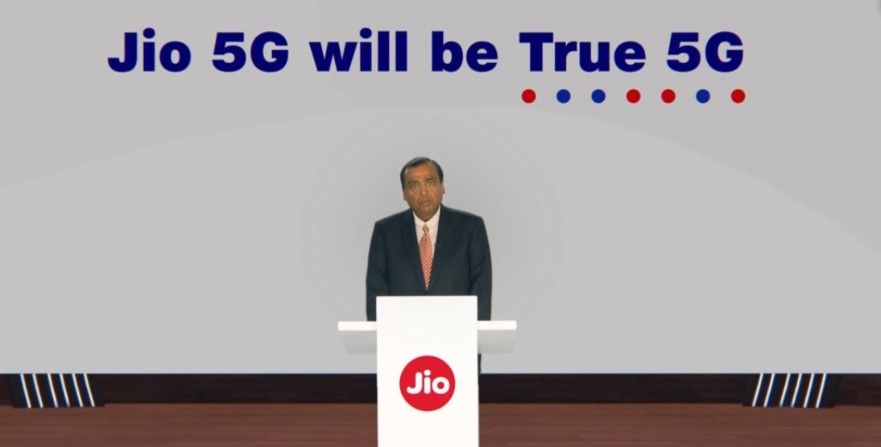
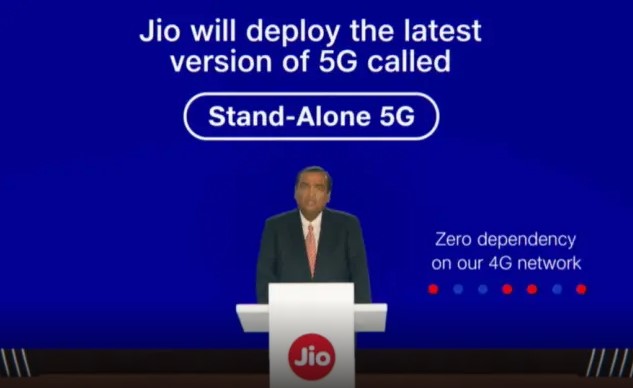
Stand-alone 5G architecture with advanced 5G network with Zero dependency on 4G network.
The largest and best mix of 5G spectrum across 700 MHz, 3500 MHz, and 26 GHz bands.
Carrier Aggregation that seamlessly combines these 5G frequencies into a single robust “data highway” using an advanced technology called Carrier Aggregation.
Starting 10th November, Jio users in Bengaluru and Hyderabad will be invited to the Jio Welcome Offer, to experience Unlimited Data at up to 1 Gbps+ speeds, at no additional cost.
• A robotic arm that will perform ultrasound • The robot will deliver medicine and food to the patient’s bed
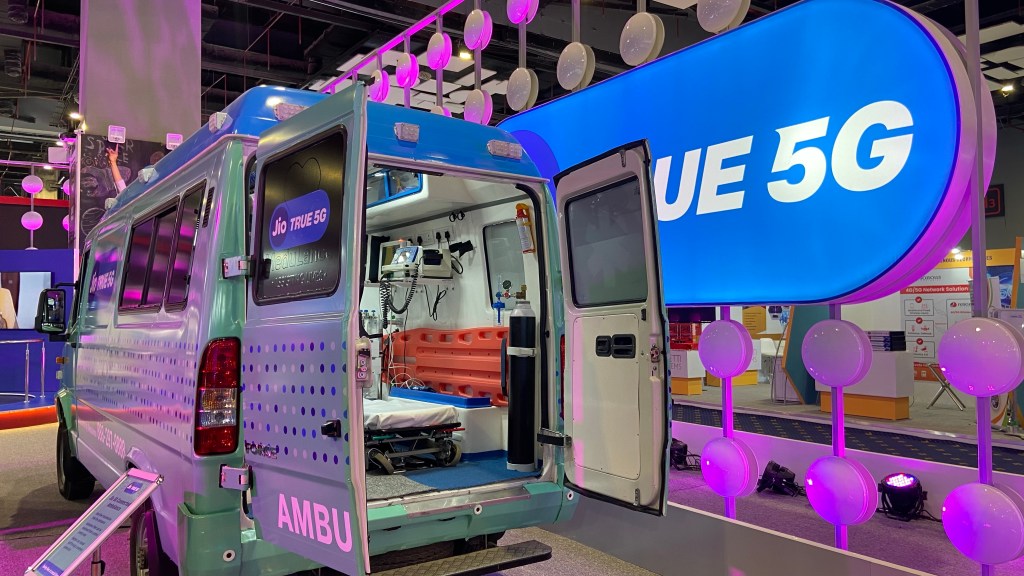
Reliance Jio has introduced a 5G connected ambulance at the Indian Mobile Congress. This is such an ambulance which will digitally deliver all the important information of the patient to the hospital in real time and that too before the patient reaches the hospital. In the event of a medical emergency, the doctor present at the hospital can make all necessary medical arrangements before the patient arrives. You can guess how much the medical industry will change in the future by looking at this ambulance.
The Jio Pavilion will also feature a robotic arm that specializes in X-rays and ultrasounds. In fact, a radiologist or sonographer sitting hundreds of miles away can easily run it through Jio True 5G. This robotic arm will directly connect city-based radiologists with rural patients. For basic medical needs like X-ray and ultrasound, villagers will no longer have to go around the city and the report will also be available at home.
Reliance is launching 5G service on Diwali. Relying on the high speed and low-latency of its True 5G network, Reliance Jio is also working on many technical solutions that will come in handy in everyday life. One of them is Jio 5G Healthcare Automation. Many frontline workers lost their lives in isolation wards of hospitals during the Kovid epidemic. Reliance Jio is working on the technology of 5G controlled robots which will be able to deliver medicines and food to isolation wards as well as other patients.
Due to the use of cloud based 5G controlled robots the margin of error will be zero. With a robot fleet management system, their maintenance and sanitization will also be easier than humans and most importantly, the lives of thousands of frontline workers and patients can be saved.
While India is awaiting the launch of 5G services by Prime Minister Narendra Modi on October 1st at India Mobile Congress (IMC) in New Delhi, Reliance Jio is all set to deliver its promise of ‘True 5G’ services to its customers.
Jio 5G promises to be a stand-alone 5G network, which is not the case with most 5G networks available in the world right now. Most operators rely on the non-standalone 5G network, which basically transmits 5G radio signals over an existing 4G network. Following this methodology is unlikely to give improved performance to the users.
Jio 5G will be called a stand-alone 5G network that will have zero dependency on its 4G network. The True 5G network can offer powerful services and deliver performance at low latency, ideal for massive machine-to-machine communication, deliver 5G voice, edge computing and network slicing, and metaverse, among others.
Jio has planned its True 5G network in a calculated manner, which started by acquiring the largest and the most appropriate mix of wireless spectrum for 5G. Jio has acquired 5G spectrums in the 3500 MHz mid-band segment, which is globally earmarked for 5G, and the 26 GHz millimeter-wave band for ultra-high capacity. But where Jio 5G becomes a True 5G network is thanks to the 700 MHz low-band spectrum which is essential for deep indoor coverage.
“Three-fold advantage of Stand-Alone 5G architecture, largest and best mix of spectrum, and Carrier Aggregation means that Jio 5G will be able to offer an unparalleled combination of coverage, capacity, quality, and affordability,” Reliance Industries Chairman, Mukesh Ambani highlighted during the recent Annual General Meeting (AGM).
Addressing shareholders he said, Jio 5G will be the world’s largest and most advanced 5G network as the carrier is planning to deploy the latest version of 5G, called Stand Alone 5G, that will have no dependency on its 4G network.
In contrast, rivals are looking at Non-Stand Alone 5G, which was called a “hasty way to nominally claim’’ a 5G launch.
Jio was the only carrier to have acquired expensive spectrum in the 700 MHz band by spending almost 40,000 crore rupees in an auction earlier this year, when no other rival thought the airwaves were worth the money.
The 700 MHz band provides better network coverage due to low frequency and has the ability to penetrate buildings efficiently. This will enable it to offer better, stable and faster connectivity in dense urban areas such as Delhi, Mumbai, Kolkata, Hyderabad, etc, experts said.
The acquisition of pan-India 700 MHz band by Jio has also been targeted at attracting high end users to its network aiming to become the primary SIM for them. The driving factor for high average revenue per user (ARPU) users will be an offer of better voice call quality indoors and differentiated 5G offerings. Jio is working with Google to develop an ultra-low cost 5G smartphone which will further strengthen the offerings of the largest telecom player.
Stand Alone 5G vs Non-Stand Alone 5G
Jio is betting that a Stand Alone network with its 700 MHz band will ensure better consumer experience which could drive higher revenue market share and reduce network operating costs. It also has long-term advantages like superior quality ultra-low latency 5G experience and differentiated and wider range of applications particularly for the key enterprise segment.
For Jio, a launch in sub-GHz bands will ensure better consumer experience which could drive higher revenue market share and reduce network operating costs. It also has long-term advantages like superior quality ultra-low latency 5G experience and differentiated and wider range of applications particularly for the key enterprise segment.
This could help the company to poach high-end customers from its competitors – likely increasing competition at the high end, analysts observe.
Also, it costs less to provide broadband services in the 700 MHz band as compared to, say, the 2,100 MHz band. A sub-GHz band— bands below 1000 MHz—offers better coverage with speed without consuming much power.
Jio will be launching 5G services in key cities including metro cities by Diwali with a gradual expansion month-on-month and by the end of December 2023, every part of the country will be covered with Jio 5G. It has announced an investment of Rs 2 lakh crore to build Jio 5G.
In almost a week’s time, it is possible that you start seeing the 5G icon in your smartphone’s status bar. After the spectrum concluded successfully in July, telecom operators in India set out to fast-track the process of 5G deployment. While Jio and Airtel will kick off 5G services as early as October, Vi might take some time, but in any case, metro cities will be the first to get them. So, while companies are making sure they offer the best 5G services, customers also have certain things to do to be able to experience 5G. There are a lot of questions pertaining to 5G that customers want answers to.
When will 5G become available? How will I get it? Do I need a new phone? Which phone should I get? Do I need a new SIM card? People have endless questions right now, but some of them are important.
Do I need 5G?
If you keep the concept of lifestyle upgrade aside, the answer to this question lies in what you want from your internet connection. Fast internet will do things such as stream high-quality videos without buffering, play high-graphics games with the lowest latency, and use several devices without having to worry about a slowdown in your connection speed. It will understandably be tempting to get a 5G connection maybe because of curiosity or because of peer pressure. However, you have to decide whether you need it or not.
5G will provide the bandwidth and latency to enjoy uninterrupted access to services such as high-definition video streaming, mobile gaming, and video calling on the go. A consumer survey of Indian smartphone users showed that 42 percent believed faster network speeds would most improve their mobile service, followed by a more reliable connection and better indoor coverage. The spectrum that Indian operators acquired at auction, across the prize C-band and sub-1GHz will offer a blend of high capacity and coverage. In terms of top-line speeds, an analysis of other 5G markets shows that 5G speeds are between 7-10 times higher than 4G.
And if you are willing to upgrade, make sure you look for incentives to do so — much likereasons4G was introduced in India. One of the reasons behind the aggressive pricing of tariffs is the competition, but it has reduced since then. The market dynamics have also changed. Both these factors, combined with the demand for 5G, will affect the incentivisation of 5G services.
When Reliance Jio launched in 2016, it offered free voice and data on its new 4G network for almost 6 months, in a bid to disrupt the market and gain share. A lot has changed since then, with prices stabilizing and consolidation reducing the number of competitors. As Indian operators look to establish early 5G leads, we’d expect to see attractive 5G upgrade offers hit the market. Jio has even confirmed that it is working on a 5G smartphone, which will likely push the boundary in terms of affordable 5G devices, helping to spur adoption.
Is my phone 5G ready?
There is a simple way to check if your phone supports 5G or not. While chances are that it will, considering the first 5G phone landed in India back in 2019, you can always go to your phone’s network settings and look for supported networks or preferred network type for your SIM card. If it says 5G anywhere, your phone supports 5G. Most Android phones, as well as the latest iPhones (iPhone 12 and later upgrades), support 5G, and their market distribution is favourable for the rollout.
According to a survey by Ookla, Indians are testing the speed of their mobile internet connection using a 5G phone. The survey found out that many Indian users are already running the Speedtest app using 5G-capable devices, indicating that for a significant proportion of users, a 5G upgrade could be as simple as purchasing a new mobile plan, and avoiding a costly handset upgrade. 5G is a staple feature of not only flagship devices but also mid-tier devices today.
But if you do not see 5G mentioned anywhere in your phone’s mobile data network settings, your phone is not 5G supported, in which case you should go shopping. Customers can find attractive offers on 5G handsets during this festival season.
Do I need a 5G phone?
5G will be available across different Indian cities and towns by next year, but right now, only the metro cities will get the coverage. If you live in New Delhi, Mumbai, Kolkata, Chennai, Hyderabad, or Bengaluru you should buy a 5G phone if you want to experience faster internet speeds. Other cities, such as Ahmedabad, Lucknow, Chandigarh, Vijayawada, Vishakhapatnam, and Gurugram will get 5G connectivity sometime later. So, if you live in one of these cities, buying a 5G phone makes sense. But if you live in a location that is not a part of the immediate roadmap, you can hold off until the announcement.
While 5G’s launch is imminent according to prime minister Narendra Modi, it will take operators time to expand the coverage of their 5G networks. The DoT has outlined a list of thirteen cities where 5G will launch first. Expect coverage in large cities first, as operators work down the list of targets based on anticipated return on investment. Jio already claims to have completed 5G coverage planning in the top 100 Indian cities, while Airtel has ambitious plans to cover all towns and cities, including rural areas, by 2024.
What are my options?
Brands such as Samsung, Xiaomi, POCO, Realme, and Vivo are leading the 5G smartphone market across price ranges. With strategic tie-ups with 5G chipset makers, MediaTek and Qualcomm, OEMs have been able to offer 5G smartphones in India for as low as Rs 15,000. And while that is promising for quick adoption of 5G services, brands such as Realme have promised to launch 5G phones for under Rs 10,000.
These handset manufacturers are working closely with leading chipset makers to bring powerful 5G processors to young users. 5G being yet another disruption in the communications industry, they are on top of 5G. They aim to democratize 5G technology further so that the masses can experience the technology.
What should I look for while buying my 5G phone?
The most important thing to look for here is 5G, obviously, but that should not be the only criterion to buy your next phone. 5G is ubiquitous on phones today — with the word “5G” printed on retail boxes, so you are unlikely to leave out 5G as a feature on your phone. So, let us talk about the things that you should pay attention to.
A 5G-ready phone is not enough. You need to check what 5G bands your phone supports and that information is easily available on the retail box of the phone. You have three bands in the 5G spectrum that telecom companies have acquired: low-band, mid-band, and high-band. The low band has a 700MHz spectrum, also known as n28, while the mid-band has 3500MHz, called n78. Nearly every 5G phone supports the n78 band, but you are likely to find n28 in more expensive 5G phones. That is because 700MHz is meant for standalone 5G services, or SA 5G, which only Reliance Jio will be able to offer. The high-band has a 26GHz spectrum called mmWave and n258. A handful of phones will support n258 since it is mmWave connectivity is unlikely to be available to consumers, at least initially.
5G aside, you have other specifications to consider. The display, the processor, the camera, and the battery — each has its own importance per your needs from your phone. If you are into binge-watching, buy a phone that has a good display and loud speakers. If you are hooked on gaming, go for a phone with a fast processor, a smooth display, and a thermal cooling system. If you are going to use the internet a lot, display and battery are the important things to consider.
“Consumers should also focus on basics like processor, camera, battery size, and charger for a complete package. These features will accentuate the 5G experience as users get higher internet speed and can manage multiple functionalities better,” said the Xiaomi spokesperson.
Realme’s Sheth echoed the same sentiment, saying, “When it comes to buying 5G smartphones it’s not about the network only, it is also about the experience and enhanced performance a 5G smartphone has to offer to users. As the 5G ecosystem evolves, the smartphone form factors will change along with the environment. Consumers, for instance, favour a svelte, light, and compact structure. Even though 5G smartphones integrate additional components like antennas etc, the design and build quality are also of enormous importance.”
How fast will be 5G?
While 5G networks around the world have managed to deliver speeds of over 1Gbps to customers, Indian telcos have promised a manifold increase in download and upload speeds over 4G.
5G speeds will also depend on your location, besides the operator. Jio has acquired additional spectrum in many circles, so you are likely to get better connectivity and speeds in these locations.
Differences in spectrum holdings, network infrastructure, and rollout strategies mean that 5G performance between operators will diverge. Understanding the top performing 5G network in your region will be critical to ensuring you have the best experience for network-intensive activities.
The telecom carriers in India are expected to invest around $19.5 billion in the development of advanced infrastructure for 5G by 2025, according to a GSMA report.
The report showed that 5G could benefit the Indian economy by $455 billion between 2023 and 2040, or more than 0.6 per cent of the GDP forecast for 2040, reflecting the large number of 5G use cases that could be implemented in the main sectors of India’s economy.
“5G benefits are expected to be realised in new applications in the manufacturing sector (representing 20 per cent of the total benefit) as well as the retail, ICT and agricultural sectors,” the findings showed.
However, while the Indian government has assigned two carriers of 250 MHz each in the E-band to address the current need to support 5G rollouts, this may not be enough in the 5G era given the requirement for high-capacity backhaul to support use cases and increased data traffic.
“Clear policy guidelines on the allocation of backhaul spectrum arenecessary,” the report said.
5G will be a key enabler of enterprise digital transformation processes across manufacturing, energy and utilities, banking, transportation, healthcare, sports and retail in the country.
“The consumer and enterprise segments both present significant opportunities for 5G services in India. However, further reforms are required to support the development of advanced telecom infrastructure is a fundamental driver for a digital society,” said the report titled ‘India: on the road to a digital nation’.
There still exists a substantial digital divide in India, with lack of literacy and skills remaining the greatest barrier preventing large swathes of the population from participating in the digital economy and the social and economic benefits it can bring to their lives.
“Given the importance of 5G to India’s digital future, it has become critical for the government and the mobile industry to collectively evolve and ensure the sustainable growth of the mobile industry,” the GSMA report mentioned.
While Reliance Jio rolls out standalone 5G services in select cities in the country by Diwali, which falls on October 24, Bharti Airtel is set to kick off 5G roll out within a month.
Union IT Minister Ashwini Vaishnaw has also said that 5G services are expected to be rolled out from October. (IANS Report)
5G launch in India in India is in full swing. The Department of Telecommunications (DoT) has announced that the 5G services will roll out this year. Jio, Airtel, and Vi, on the other hand, have been long working towards making the network that can virtually connect everyone and everything together including machines, objects, and devices such as 5G-capable smartphones a reality in the country. That said, don’t expect the countrywide availability of the network immediately after the launch. The 5G services will take time to mature and initially be available in a handful of cities.
The Indigenous 5G testbed project, funded by the telecom department, has been completed by December 31st, 2021. The government is now gearing up for the 5G spectrum auction, which is expected in early June. Following this, the 5G services will start rolling out in India from August-September onwards. Airtel and Jio both have claimed to be the first telecom operator to launch the 5G network in India.
DoT in a press statement has confirmed that the 5G services will be available in as many as 13 cities across the country in 2022. These cities include Delhi, Gurugram, Bengaluru, Kolkata, Chandigarh, Jamnagar, Ahmedabad, Chennai, Hyderabad, Lucknow, Pune, and Gandhi Nagar. All three major telecom operators, Jio, Airtel, and Vi (Vodafone Idea), have already set up 5G trial sites in these cities.
Jio to pioneer the 5G network revolution
Jio is said to pioneer the 5G network revolution in India. The company’s chairman Mukesh Ambani has announced that it’ll take the lead on the network in the country. Jio claims that it’ll easily upgrade to a 5G network from 4G, owing to the telco’s converged network infrastructure. Jio’s 5G will be powered by the indigenously developed network, hardware and technology components, Ambani added. It’s believed that the telco may buy 700MHz in the upcoming auction to fulfil its 5G ambitions unless the government announced the auction of 3300-3600MHz, which is globally popular for 5G deployments at the moment.
Airtel is yet to reveal its plans to launch 5G in the country. The company believes that the next generation of mobile technology needs more time to be rolled out across the country. As per Airtel chief executive Gopal Vittal, the 5G ecosystem in the country is underdeveloped right now and that spectrum is expensive. “The fundamental issue with 5G is spectrum cost, which is way over the top,” he added. That said, the telco is 5G-ready. Airtel announced the deployment of India’s first state-of-the-art Massive Multiple-Input Multiple-Output (MIMO) technology, which is a key enabler for 5G networks, in 2017. The company has already deployed the technology in Bangalore, Kolkata, and several other regions in the country.
Vodafone Idea is all set to roll out 5G in India as soon as the spectrum is made available through auction. The company has upgraded its 4G network with 5G architecture and other technologies like dynamic spectrum refarming (DSR) and MIMO. “Our network is very much 5G-ready. When the 5G auction takes place, we will be able to launch 5G. However, there is a need to develop India 5G use cases. India is unique and some global use cases might not be relevant,” Vodafone Idea MD and CEO Ravinder Takkar said during the AGM meeting last year. The telco has also proposed 5G trials with multiple vendors, including Huawei and Ericsson.
Termed ‘the network of networks,’ the fifth generation of wireless mobile networks, 5G will set the benchmark for wireless network standards- A Republic World Report
In a major development, India’s biggest spectrum auction, which will pave the way for high-speed 5G services, is likely to conclude by July end. The rollout of 5G is expected to happen by September this year, union Telecommunication and IT Minister Ashwini Vaishnaw had informed. The Centre approved the 5G spectrum auction, which is now scheduled to commence on July 26.
The fifth generation of wireless mobile networks, 5G will set the benchmark for network standards. Compared to previous generations – 2G, 3G and 4G, the 5G network is set and offers much higher data speeds. Termed ‘the network of networks,’ 5G is expected to be more reliable with lower response times and greater capacity. The network is due to unite many existing standards and cross different technologies while bettering all services on the internet.
Why do we need 5G?
The most evident advantage of the 5G network is the high speed. The increased speed will enable seamless buffering, and greater downloads while helping e-commerce. Reduced latency means faster response time. The increased speed will also open up a large potential application across industries. 5G mobile telecommunications is expected to support the creation of smart factories along with other services like holographic technologies etc.
The Centre has mentioned that in eight top technology institutes of India, the 5G test bed is set up which is speeding up the launch of domestic 5G technology in India. For the launch of 5G services, India is soon to get a strong ecosystem which will likely to about 10 times faster than 4G. It is noted that in the entire 5G ecosystem, Spectrum is an integral and necessary part.
5G rollout in India
In an auction to be held by the end of July 2022, a total of 72097.85 MHz of spectrum with a validity period of 20 years will be put up. The auction will be held for spectrum in various Low (600 MHz, 700 MHz, 800 MHz, 900 MHz, 1800 MHz, 2100 MHz, 2300 MHz), Mid (3300 MHz) and High (26 GHz) frequency bands. Airwaves worth Rs 4.3 lakh crores is expected to be sold at the auction.
Meanwhile, it is being said that the bidders will be given an option to surrender the spectrum after 10 years with no future liabilities with respect to balance instalments. According to reports, the initial rollout will begin in August in a phased manner and full-fledged 5G services will be rolled out by March 2023. Reliance Jio, Bharti Airtel and Vodafone India are being said to be the main buyers.
Blockchain technology is foraying into multiple sectors from finance to healthcare but perhaps its most revolutionizing venture has been in the gaming industry. From a zero-value market size, the blockchain gaming industry grew to $3 billion in 2021. Furthermore, it is projected to rise to $39.7 billion by 2025. Fuelled by NFT (Non Fungible Tokens) generation capabilities, free-to-play and play-to-earn models, the blockchain gaming industry has attracted over 1.5 million diverse gamers across the globe.
By leveraging technologies like NFTs, blockchain games are making ownership of in-game assets easier, economical and trustless. The endless possibilities of blockchain technology in the gaming world are attracting millions of gamers and investors from across the globe. Despite the strong growth trends and potential for profit in the blockchain gaming industry, the market abounds with challenges and obstacles. Click here to dive deeper into the world of blockchain gaming and understand its key drivers and challenges.
Telecom players are increasingly looking to the gaming sector for new revenue opportunities, but disruptive and ground-breaking applications enabled by augmented reality (AR) and 5G’s combination of high data throughput and low latency and are yet to be developed, according to industry analysts.
With the heat now on for telcos to identify ways to get a return on their 5G investments and develop new opportunities using the capabilities the latest mobile broadband generation has to offer, there has been plenty of activity in this area in recent months. Last week, US operator Verizon unveiled work on an AR adventure thriller that uses volumetric video (modern 3D holograms) to provide “an unbelievable immersive experience.” The production, called Helios, is being developed in partnership with immersive studio Novelab and 30 Ninjas, a digital entertainment company co-founded by film director and producer Doug Liman.
Supported by Verizon’s 5G Ultra Wideband 5G service, the immersive experience will allow users of 5G-capable Android and iOS smartphones to follow the plotline of a missing character and uncover the mystery by navigating the story and piecing clues together.
In addition to Verizon, Deutsche Telekom, EE, Globe Telecom, Orange, SK Telecom, SoftBank Corp. and TELUS have joined Niantic’s Planet-Scale AR Alliance, which has a mission to create “amazing real-world AR experiences that demonstrate the possibilities of 5G,” including ultra-reliable low latency, enhanced mobile broadband, network slicing and edge computing.
We’ve already seen some interesting attempts this year, as Japanese operator KDDI touted a successful use of network slicing and 5G standalone (SA) for 8K PlayStation game streaming. The demonstration was announced in February and is part of an initiative with Sony to create new business use cases and entertainment services based on 5G SA.
At the start of the year, US operator AT&T joined forces with NVIDIA to offer 5G GeForce NOW subscriptions, which it claimed offers “one of the world’s best gaming experiences.”
Another example in the gaming and immersive content field involves South Korean telco SK Telecom, which claimed it turned the country into the first Asian market to offer Microsoft Xbox’s cloud gaming service in 2020: A year later it created an AR app based on 5G edge cloud designed to offer immersive experiences for tourists.
Analysts feel that the introduction of new features and services, such as gaming on the move, some AR apps and 8K videos, which require greater bandwidth and higher speeds, will help to highlight the merits of 5G.
Content will also have a huge role, as it is paramount in driving uptake and usage of next-generation networks. Therefore, expect all providers shouting as loud as possible about how good their fibre and 5G networks are, as rollout ramps up significantly.
After all, the big challenge for telecoms operators remains: How to find the right partnerships, content and marketing strategies to convince their existing and new customers that upgrading to the fastest network out there is, in fact, more needed than ever. (Telecom TV Report)
Social media networks are jumping on the NFT (non-fungible tokens) bandwagon. It all started when the ‘Twitter Blue’ account users were offered to put NFTs as profile pictures. Later, Meta has rolled out 3D Avatars for Facebook, Messenger, and Instagram and allowed users in the US, Canada, and Mexico to beam their virtual selves across apps via stickers, profile pictures, and feed posts. Meanwhile, YouTube has been distributing personalised NFTs to the influencers on the platform. Additionally, Reddit has launched a first test for changing profile pictures with an NFT.
NFT market
According to Emergen Research, the global Non-Fungible Token (NFT) market size reached USD 340 million in 2020 and is expected to cross USD 3,50,000 million in 2030. Pak’s NFT artwork fetched a whopping USD 91.8 million: The Merge was sold in 266,445 units known as ‘mass’. Earlier, digital artist Mike Winklemann, also known as Beeple, sold his artwork, ‘Everydays – The First 5000 Days’, for USD 69.3 million.
NFTs are currently not created, bought or sold on social media platforms. But, the inherently social nature of the artworks aligns with the social media networks’ DNA. Though social media platforms passively shape the future of NFTs, they want more skin in the game. Experts think tech giants believe NFTs will assume the trajectory of cryptocurrency– a slow start, followed by an explosion.




 GO DIGITAL